


Readiness & Writing
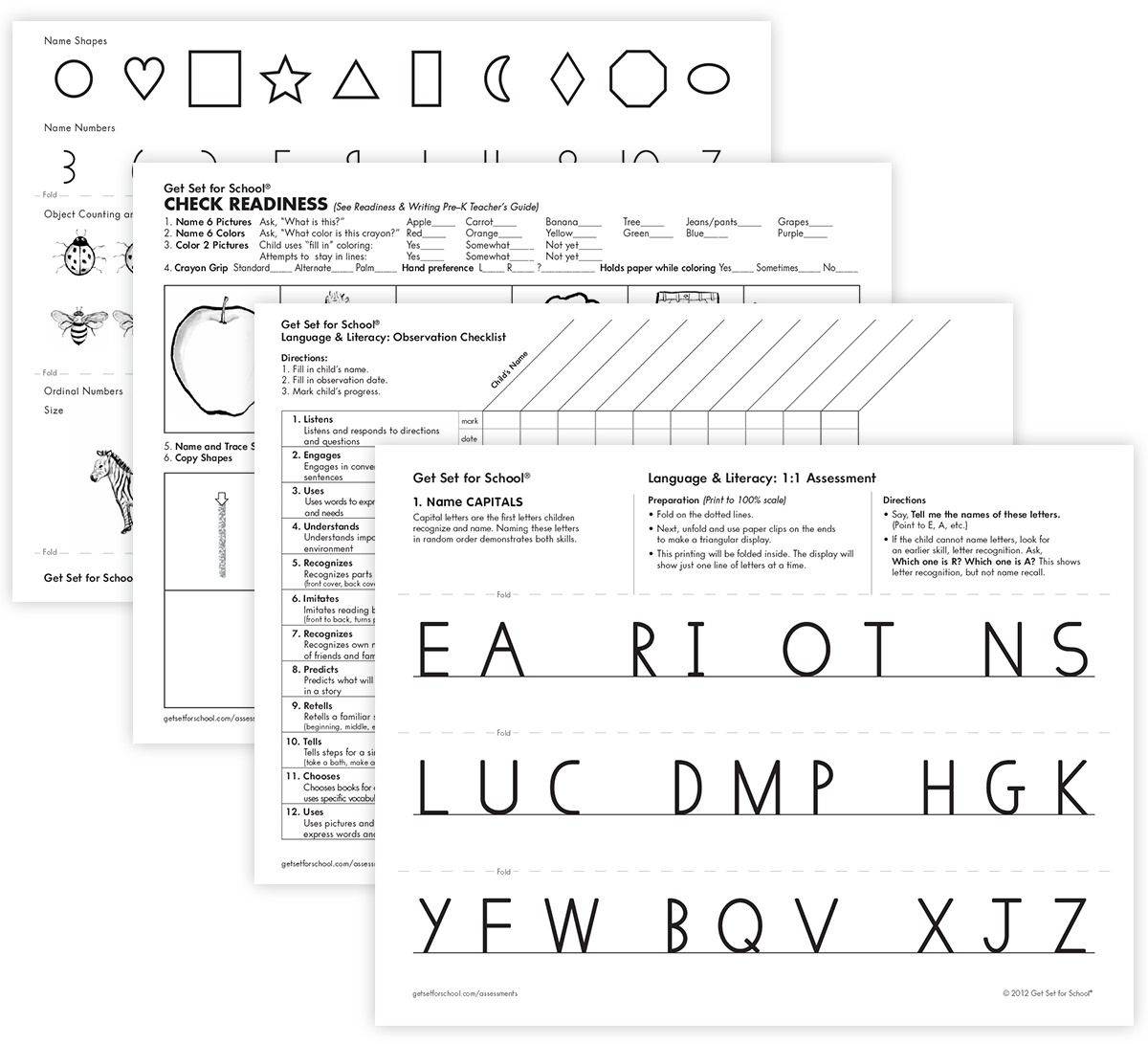
The Readiness & Writing 1:1 Assessment can be used to assess Pre-K children as they develop their skills. You will assess naming colors, shapes, crayon grip, letter naming and writing. Keep track of a child’s response on the Assessment. As you watch children play and participate in activities use our Observation Checklist to note additional skills.
Download includes assessment, directions and observation checklist pages.
Language & Literacy
The Language & Literacy 1:1 Assessment can be used to assess Pre-K children as their skills develop. You will assess letter naming, describing and comparing, rhyming, and words/word parts. As you watch children play and participate in activities use our Observation Checklist to note other skills. Keeping track of a child’s response is made easy with our new 1:1 Assessment Record.
Download includes assessment, directions and observation checklist pages.
Numbers & Math
Numbers & Math
Use the Numbers & Math 1:1 Assessment to assess skills as they develop. You will assess naming numbers, counting and comparing, positions, ordinal numbers, and AB patterns. As children play and participate in math activities use the Observation Checklist to note their development with other skills. Keep track of a child’s response with our new 1:1 Assessment Record.
Download includes assessment, directions and observation checklist pages.
Keeping track of a Pre-K child’s progress is easier using our new Portfolios handout. Use our Portfolios handout to learn more about their purpose and how they can be used in your Pre-K classroom/center. We offer suggestions for how and when to create portfolios and what types of work samples to include. Tips are provided for how portfolios can be shared with families or colleagues.
Traditional paper and pencil forms of assessment are not appropriate for Pre-K children. Our developmentally appropriate assessments address young children’s growth in Language & Literacy, Numbers & Math, and Readiness & Writing skills.
They will help you to:
1. Identify the different learning experiences of all children in your class
2. Plan meaningful learning experiences
3. Measure children’s academic progress
4. Gather information to share with families, specialists, educators, and administrators
5. Identify children who might benefit from special services
Assessing young children should be observational and holistic, impacting your hands-on instructional time as little as possible. We recommend using the assessments with each child three times a year: at the beginning, middle and end of their Pre-K year.
Each assessment takes just 10-15 minutes.
Look at each assessment as a snapshot in time. Looking at those snapshots over weeks and months shows the path of a child’s development and learning. Use these assessment tools along with your daily experiences and professional judgment. Do not make decisions about a child’s long-term grouping or placement based on a single assessment.
Pre-K teachers, therapists and parents can use these assessments. They are universal and developmentally appropriate for children ages 4-5.
Some people you might want to consider include fellow Pre-K teachers, parents, therapists, administrators, and kindergarten teachers. This will provide all of those involved a clearer understanding of the child’s progress.